Laser Processing Capabilities
We build standalone laser cells for marking, engraving, and surface processing. If your part does not fit a standard cell, we can prove the process on our floor and help you choose the best path forward.
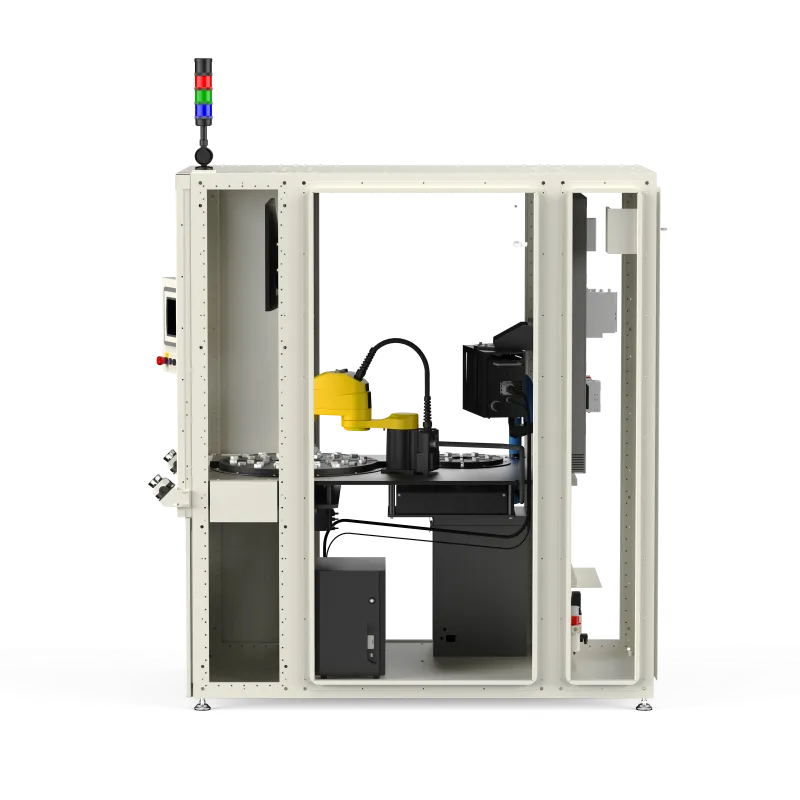
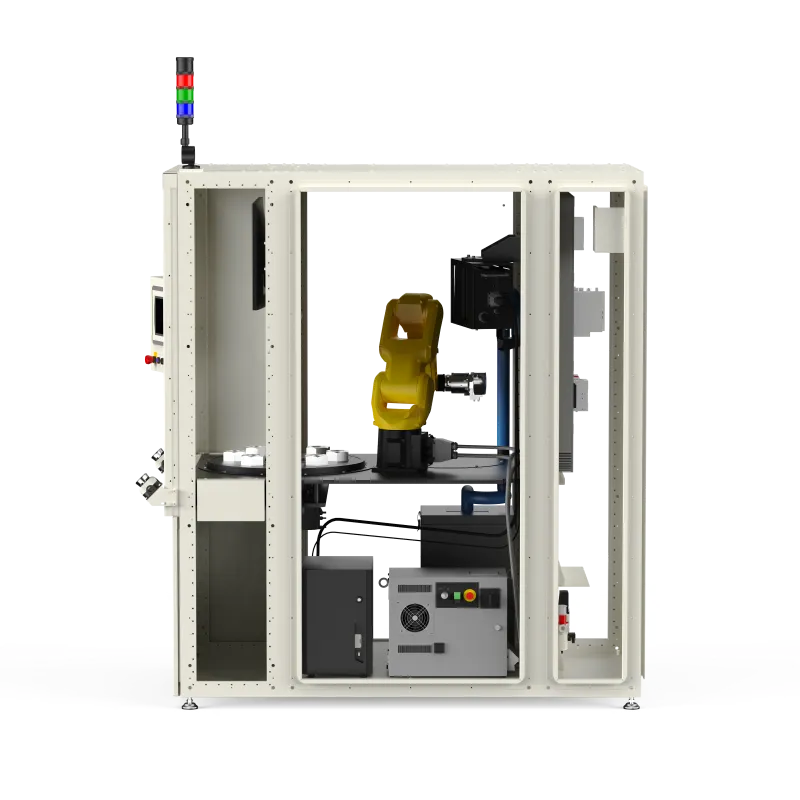
Proven Before PO. Built Complete Before Shipment.
We do not expect customers to approve a laser system based only on theory. Before a PO, we can test your actual part, confirm the marking process, and provide proof that the application works.
After the order, the system is built as a standalone cell on our floor. The laser, fixture, guarding, controls, safety, part handling, and required interfaces are integrated before the machine ships.
A cell does not leave HQA until the application is proven. When it arrives at your facility, the goal is simple: connect utilities, complete setup, train operators, and move into production without turning the installation into a long integration project.
Standard Cell Foundation
To reduce lead time, we build from a standard heavy-duty cell base. The frame, guarding, electrical cabinet, controls, safety system, and basic layout are already defined.
This gives each project a proven starting point. It also helps us use common components, common wiring practices, and a common service approach across different machines.
Learn how our Modular Platform works →While our ready laser cells cover many common marking applications, some parts need a different loading method, fixture, verification step, robot layout, or interface to other equipment.
Built Around Your Part Handling
The laser is only one part of the system. In production, the harder question is usually how the part gets loaded, positioned, marked, checked, and unloaded.
If your application requires multi-step processing, vision verification, bowl feeding, tray loading, robotic handling, or a custom fixture, we can modify the cell around that process while still using the standard cell base.
See our Custom Application capabilities →Part Geometry & Surfaces
Different parts require different laser access, focus control, and handling. We can support flat parts, curved parts, cylindrical parts, and parts that need to be processed on more than one side.
Flat 2D Surfaces
Standard marking for tags, plates, nameplates, and flat component faces. These applications usually use a fixed focal distance and simple fixtures.
Stepped & Curved Surfaces
For parts with height changes or curved surfaces, the laser setup must control focus and mark distortion. This can require 3-axis laser control, Z adjustment, or custom fixturing.
Cylindrical Parts
Round parts may require a rotary chuck or rotary fixture so the part can turn during marking. This allows marks to wrap around tubes, shafts, or other cylindrical surfaces.
Multi-Face Processing
Some parts need marks on more than one side. A 6-axis robot or custom handling system can present different faces of the part to the laser in sequence.
Material & Wavelength
The right laser depends on the material, required mark quality, heat sensitivity, mark depth, and cycle time. We review the part first, then select the laser type that fits the application.
Fiber & YVO4 Lasers
Common choices for metal marking. These lasers are used for stainless steel, aluminum, steel, brass, titanium, anodized aluminum, and many industrial components.
UV & Green Lasers
Used when the part is sensitive to heat or when a cleaner mark is needed on plastics, electronics, coatings, or medical components.
CO2 Gas Lasers
Used for many non-metal materials, including certain plastics, rubber, wood, packaging materials, labels, and organic materials.
Advanced Processing & Cycle Times
Laser systems can do more than simple marking. They can also support surface cleaning, coating removal, roughening, texturing, and deeper engraving. The times below are examples for a small processing area. Actual cycle time depends on the material, surface finish, mark size, mark depth, lens, contrast requirement, and verification method.
| Type of Processing | 13W Laser | 25W Laser |
|---|---|---|
| Standard Traceability Annealing High-contrast surface marking for serial numbers, logos, and 2D codes. This is common where the mark must be readable but material removal is not required. | 3.0s – 4.0s | 1.5s – 2.0s |
| Surface Cleaning & Peeling Used to remove oil, coating, contamination, or surface material before welding, bonding, assembly, or inspection. | 4.0s – 5.0s | 2.0s – 3.0s |
| Surface Roughening / Texturing Used to change the surface finish and improve bonding, adhesion, solder wetting, or coating performance. | 6.0s – 8.0s | 3.0s – 4.5s |
| Deep Engraving Used when the mark needs to remain visible after wear, paint, powder coating, galvanizing, cleaning, or harsh use. | 12.0s – 15.0s | 5.0s – 7.0s |
*Based on a 10x10mm surface area. Final cycle time is confirmed during application testing.